A few days ago, Blackbaud University held a webinar for the company’s nonprofit customers titled “Are You Ready for Agentic AI? A Human First Readiness Check for Nonprofits.” The session came one day after Blackbaud announced four new AI agents for its platform, so this was the education arm briefing practitioners the morning after a product launch.
What was said in that hour has disturbed us since. You can watch the replay or read the transcript we prepared.
The presenter, by his own description an educator rather than a salesperson, was plain about what this new class of software does. The new Blackbaud Development Agent “has agency,” he explained. “It’s doing its own thing with human oversight.”
He now had our full attention.
“It is going to be taking action,” he said. “That is its job. It is going to be reaching out to your donors.”
Had we heard that correctly?
He encouraged customers to give the agent a name, “because it does help with relatability.” The same presentation assured the audience that “the agents should never pretend to be a full person.”
From what we could tell during the webinar, the new Development Agent was well received. A school’s advancement director anticipated its impact “for further engagement, cultivation, stewardship, and solicitations,” and the presenter welcomed the comment: “I love that this agent is involved in every step of that donor life cycle.”
One of us (Meyers) asked from the floor whether the sudden wave of donor surveys he has been receiving means organizations are readying their records for AI. The answer allowed that it is “probably a mix of technology and training and timing.”
The hour had its careful moments. The data-readiness checklist included solicit codes and consent, the presenter pressed the point about people who should not be contacted at all, he repeated that agents do not replace people, and he offered, unprompted, the most important sentence of the session: “Just because we have the capacity to communicate in a certain way does not mean that we should.”
On that last point, we agree with him completely. It’s one thing for a software vendor to offer a product that tears down philanthropy and quite another for nonprofits to help it do so. We expect software companies to act in their own profit interests. But we expect nonprofit professionals to act for the preservation of philanthropy.
Every so-called safeguard described in the Blackbaud presentation governs how well the agent faces the donor without a human intermediary. Not one of them asks whether it should.
So we’re asking. Should a nonprofit organization ever turn loose an AI agent to communicate directly with donors and even solicit gifts from them?
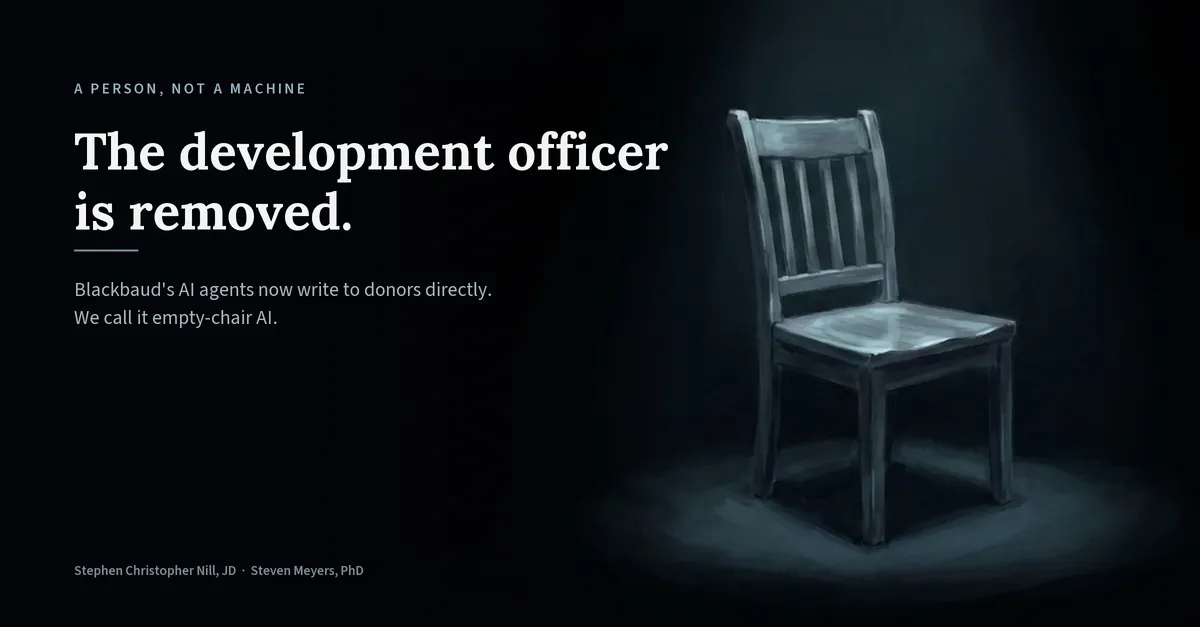
Blackbaud just pivoted from AI at your side to empty-chair AI
After the webinar, we did some research. We learned that until just recently Blackbaud limited its AI to drafting a thank-you and handing the draft to a development officer, promising that “you retain the power to revise and personalize each individual message.” A person still wrote and sent every message. Holding Fire, the book one of us (Nill) has just published, calls that arrangement AI at your side, and we have no quarrel with it. In fact, the book’s whole purpose is teaching how to work ethically with AI at your side.
But we also learned that in March of this year, Blackbaud’s Raiser’s Edge NXT gave nonprofits the ability to remove the development officer from the picture by having an AI agent communicate directly with donors. The Development Agent, according to Blackbaud, “generates personalized email and SMS conversations, adding context and making asks at the right moment.”
Supervision is offered as an option: “the ability to review and approve communications before they’re sent.”
So now the human development officer is an option?
We call this empty-chair AI: the machine replaces the development officer by communicating with the donor directly.
On July 22 came the final domino, when Blackbaud released “fully autonomous donor engagement workflows under human supervision,” aimed at “every potential or dormant donor who is not in a major gift officer portfolio.” The webinar came the morning after.
When it comes to empty-chair AI, Blackbaud did not go first. The market has been dividing into the same two classes for years, and the vendors describe their own products plainly:
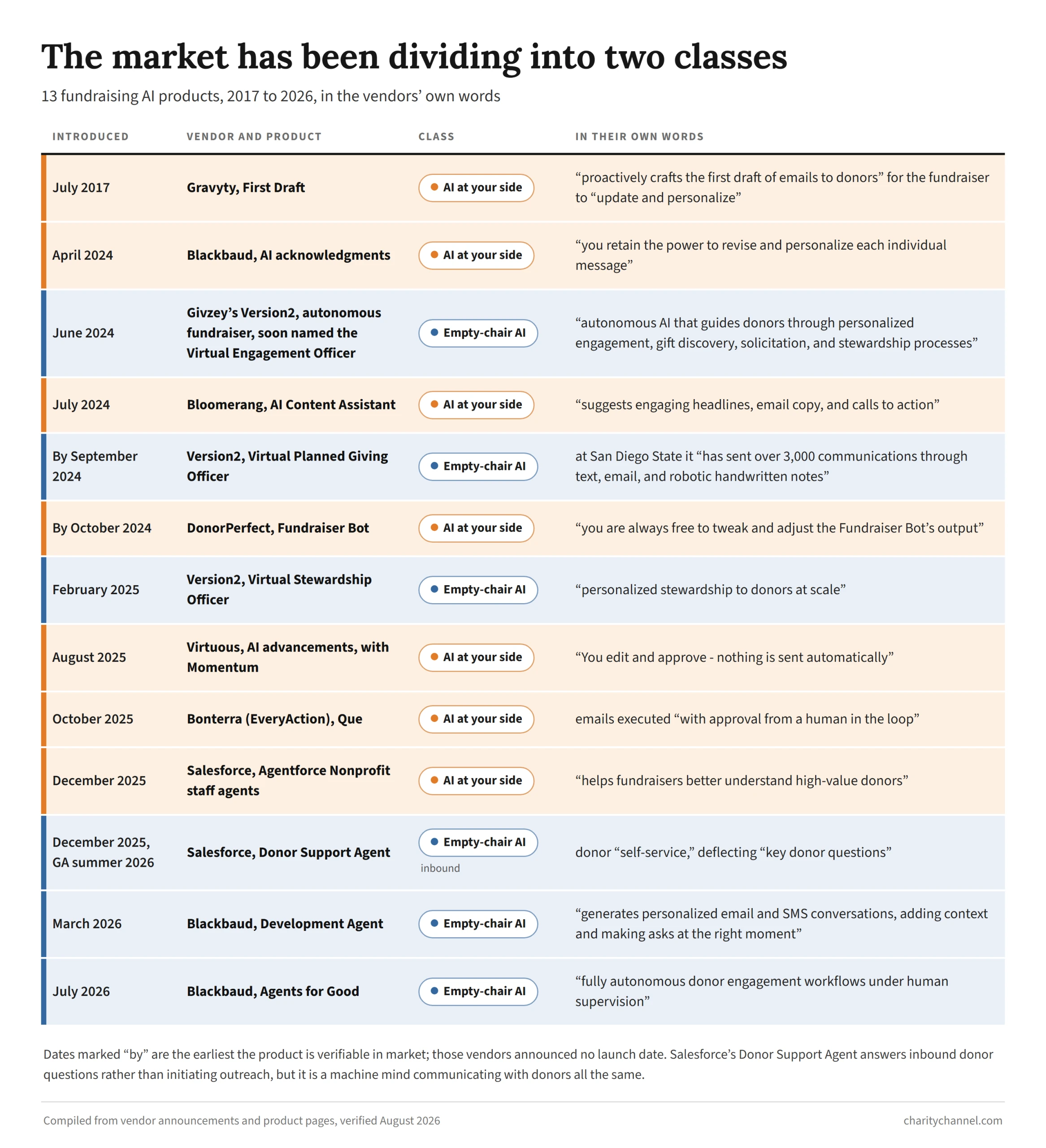
View this table as text (13 products, with sources)
| Introduced | Vendor and product | Class | In their own words |
|---|---|---|---|
| July 2017 | Gravyty, First Draft | AI at your side | “proactively crafts the first draft of emails to donors” for the fundraiser to “update and personalize” |
| April 2024 | Blackbaud, AI acknowledgments | AI at your side | “you retain the power to revise and personalize each individual message” |
| June 2024 | Givzey’s Version2, autonomous fundraiser, soon named the Virtual Engagement Officer | Empty-chair AI | “autonomous AI that guides donors through personalized engagement, gift discovery, solicitation, and stewardship processes” |
| July 2024 | Bloomerang, AI Content Assistant | AI at your side | “suggests engaging headlines, email copy, and calls to action” |
| By September 2024 | Version2, Virtual Planned Giving Officer | Empty-chair AI | at San Diego State it “has sent over 3,000 communications through text, email, and robotic handwritten notes” |
| By October 2024 | DonorPerfect, Fundraiser Bot | AI at your side | “you are always free to tweak and adjust the Fundraiser Bot’s output” |
| February 2025 | Version2, Virtual Stewardship Officer | Empty-chair AI | “personalized stewardship to donors at scale” |
| August 2025 | Virtuous, AI advancements, with Momentum | AI at your side | “You edit and approve – nothing is sent automatically” |
| October 2025 | Bonterra (EveryAction), Que | AI at your side | emails executed “with approval from a human in the loop” |
| December 2025 | Salesforce, Agentforce Nonprofit staff agents | AI at your side | “helps fundraisers better understand high-value donors” |
| December 2025, GA summer 2026 | Salesforce, Donor Support Agent | Empty-chair AI, inbound | donor “self-service,” deflecting “key donor questions” |
| March 2026 | Blackbaud, Development Agent | Empty-chair AI | “generates personalized email and SMS conversations, adding context and making asks at the right moment” |
| July 2026 | Blackbaud, Agents for Good | Empty-chair AI | “fully autonomous donor engagement workflows under human supervision” |
Dates marked “by” are the earliest the product is verifiable in market; those vendors announced no launch date. Salesforce’s Donor Support Agent answers inbound donor questions rather than initiating outreach, but it is a machine mind communicating with donors all the same.
Disclose it or hide it, it harms relationships
An office that turns the agent on its donors inherits a decision Blackbaud leaves entirely to the organization: whether donors are told that the correspondence now comes from an AI.
Walk both roads with us, because we want you to understand that disclosure to donors does not solve the ethical challenge we are all faced with:
Suppose the organization discloses. In the Journal of Business Ethics this year, Zhao, Zhou, and Chen tested charitable appeals on 118,927 people and found that appeals labeled as AI-generated drew significantly fewer clicks. Donors read the label and concluded the organization was chasing efficiency rather than mission. They pulled back. The same comparison run on commercial companies found no penalty at all; the sincerity penalty falls on nonprofits alone.
The researchers found one setting where the penalty faded: when the charity explained that its AI works behind the scenes, cutting costs so that more help reaches the people it serves, willingness to give recovered. Read that framing again, because it describes AI at your side, a tool behind a person, not an AI machine doing the corresponding. Nothing in the study, and nothing published anywhere that we can find, tests whether any explanation rescues machine correspondence itself. What would the disclosure even say? Would it admit that the warm, personal letter was generated to save staff time? The honest road for empty-chair AI is measured to lose donors where it has been tested, and untested where its defenders hope it works.
Now suppose the organization decides not to warn donors that they are now communicating directly with an AI rather than with a human representative. In this scenario, donors on the list are meant to believe a person is writing to them. The warmth, the timing, the remembered gift, and the reply that knows what they said last month are the signals fundraisers have always used to tell donors that somebody here knows them, and the agent manufactures those signals on schedule, with the friendly name as the finishing touch.
The subterfuge holds only until discovery. The problem is that AI prose has well-known tells that donors are learning to recognize. Worse, the fact that growing numbers of nonprofits are having their AI agents communicate directly with donors is becoming general knowledge on its own. Once the donor realizes all those warm messages were manufactured, trust erodes, maybe completely.
Donors have already told the profession which road they fear more. When the sector’s own responsible-AI body asked 1,031 of them last year, the fear they ranked first was AI bots portrayed as humans representing a nonprofit, and donors who said an AI-enabled organization would get less from them outnumbered those who said more by 32 percent to 14.
Disclose it or hide it, the result is the same: eroded trust. Disclose it plainly, and donors pull back now. Dress it up in mission language, and you are running an experiment no researcher has run, on your own donors. Conceal it, and they pull back at discovery, harder still.
Worse, even organizations that do not employ empty-chair AI will get caught up in the loss of trust. That’s why we consider empty-chair AI history’s biggest ethical challenge to the fundraising profession.
The decision we nonprofit professionals must make
Blackbaud and certain other vendors have lost their way, but those of us who carry the torch for our nonprofit organizations must stay on the path that sustains donor trust. An office that turns the AI agent on and aims it at its own donors is harming philanthropy because doing so erodes the relationship of the donor to the organization, and in time the relationship of all donors to all organizations.
A working alternative standard exists. It fits in one sentence: a person reads and approves every communication a donor receives. Everything else AI offers a development office, including the research, the briefings, the drafting, and the Monday morning portfolio review, stays on the table.
Our profession’s codes of ethics do not yet expressly prohibit empty-chair AI. So we have written an open letter to AFP, CGP, AHP, CASE, the Giving Institute, and every other association, roundtable, and council that sets standards for our profession, asking them to write that one sentence into the codes. The letter is short, and it is open for you to add your signature.
If you are with us, read the letter and add your name at charitychannel.com/open-letter.
Authors