The fundraising matrix is holding your donors back.
This book shows you how to break out of it.
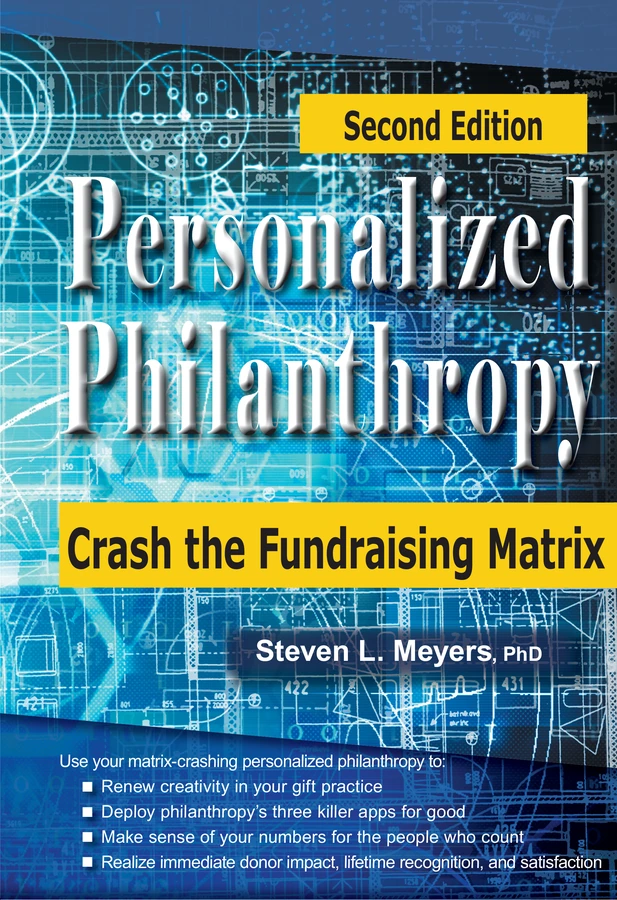
Most fundraising departments divide their work by gift type: annual giving, major gifts, planned giving. Those divisions make administrative sense. But donors don’t think about their giving that way, and organizing around gift type means every donor gets managed through a lens that was never designed with them in mind. Steven Meyers calls this the Fundraising Matrix, and Personalized Philanthropy: Crash the Fundraising Matrix is about what happens when you step outside it.
Personalized Philanthropy: Crash the Fundraising Matrix
The Right Gift, for the Right Donor, for the Right Purpose
Most fundraising shops organize themselves around gift type: annual giving, major gifts, planned giving. It makes administrative sense. But donors don’t organize their generosity that way. Donors are thinking about what they want to accomplish, what legacy they want to leave, what problem they most care about solving. The gift type is an internal accounting category. The donor’s purpose is something else entirely.
Steven Meyers calls the conventional structure the Fundraising Matrix: a system in which gift officers are sorted into silos, donors are managed accordingly, and the result is that both sides lose. Fundraisers can’t pursue the full range of a donor’s philanthropic capacity. Donors can’t design gifts that match what they actually care about. The organization’s needs and the donor’s interests are treated as competing forces instead of complementary ones.
The alternative Meyers proposes starts from the donor’s goals, not the institution’s categories. Personalized philanthropy designs gifts to mesh the donor’s most compelling interests with the organization’s most compelling needs. That shift in starting point changes everything: the conversations gift officers have, the gifts they structure, and the depth of the relationships they build.
To make personalized philanthropy practical, Meyers introduces three gift designs he calls killer apps, each one crossing the traditional lines between annual, major, and planned giving to create something more powerful than any of those categories alone. The second edition of the book adds a career guide for the aspiring enlightened generalist: the gift officer who is ready to stop working in a silo and start building something that lasts.
What’s Inside
The book includes seven chapters written for gift officers at every stage of their careers.
Two Cultures of Fundraising
Chapter 1 names the problem. Every development office operates in two cultures at once: one organized around the institution’s immediate campaign goals, and another organized around the donor’s long-term philanthropic interests. This chapter shows you what the second culture looks like in practice and what it takes to move toward it.
Matrix-Killing Apps
Chapter 2 introduces the three killer apps. The virtual endowment, the philanthropic mortgage, and the step-up gift each cross the conventional boundaries between gift types and give the donor a way to accomplish something a conventional ask could never deliver.
Radically Rethinking Endowment
Chapter 3 challenges the way development offices think about endowment as a fundraising goal. The killer apps open up endowment conversations with donors who would otherwise be left out of them entirely, and the spending-rate framework makes even modest annual giving a meaningful step toward lasting impact.
Moving Beyond Conventional Solicitation
Chapter 4 works through the gift-design process in practice. What does a discovery conversation look like when the goal is to understand the donor’s full philanthropic picture rather than close a specific transaction? This chapter provides a framework for those conversations and shows how personalized gift agreements capture both the legal commitment and the spirit behind it.
Counting, Numbers, Value and the Big Picture
Chapter 5 tackles the institutional barrier that stops many gift officers before they start: how do you count a gift that spans multiple categories and years? This chapter makes the case for counting practices that reflect the real value of long-term philanthropic relationships, and gives gift officers the language to advocate for those practices inside their organizations.
Being the Change
Chapter 6 is about taking personalized philanthropy into organizations that aren’t ready for it. Starting with one donor and one gift is enough. This chapter is about finding the place in your organization where the boundaries are most permeable and using it to demonstrate what’s possible.
A Career Guide for Enlightened Generalists
Chapter 7 is the new addition in this edition. It answers the question the first edition left open: how does an aspiring enlightened generalist actually thrive inside a conventional fundraising organization? This chapter provides a full portrait of the enlightened generalist as a job description and a career aspiration, along with strategies for pushing these values into the larger organizational culture.

The Matrix was never designed with your donor in mind.
Every donor you work with has a story about why they give, what they care about, and what they hope to accomplish through their philanthropy. Personalized philanthropy starts there, with that story, and designs the gift around it. The result is a relationship that deepens over time instead of leveling off, and gifts that grow because they’re built on what the donor actually cares about, not on the category they were assigned to. Personalized Philanthropy: Crash the Fundraising Matrix is the guide for getting there.